

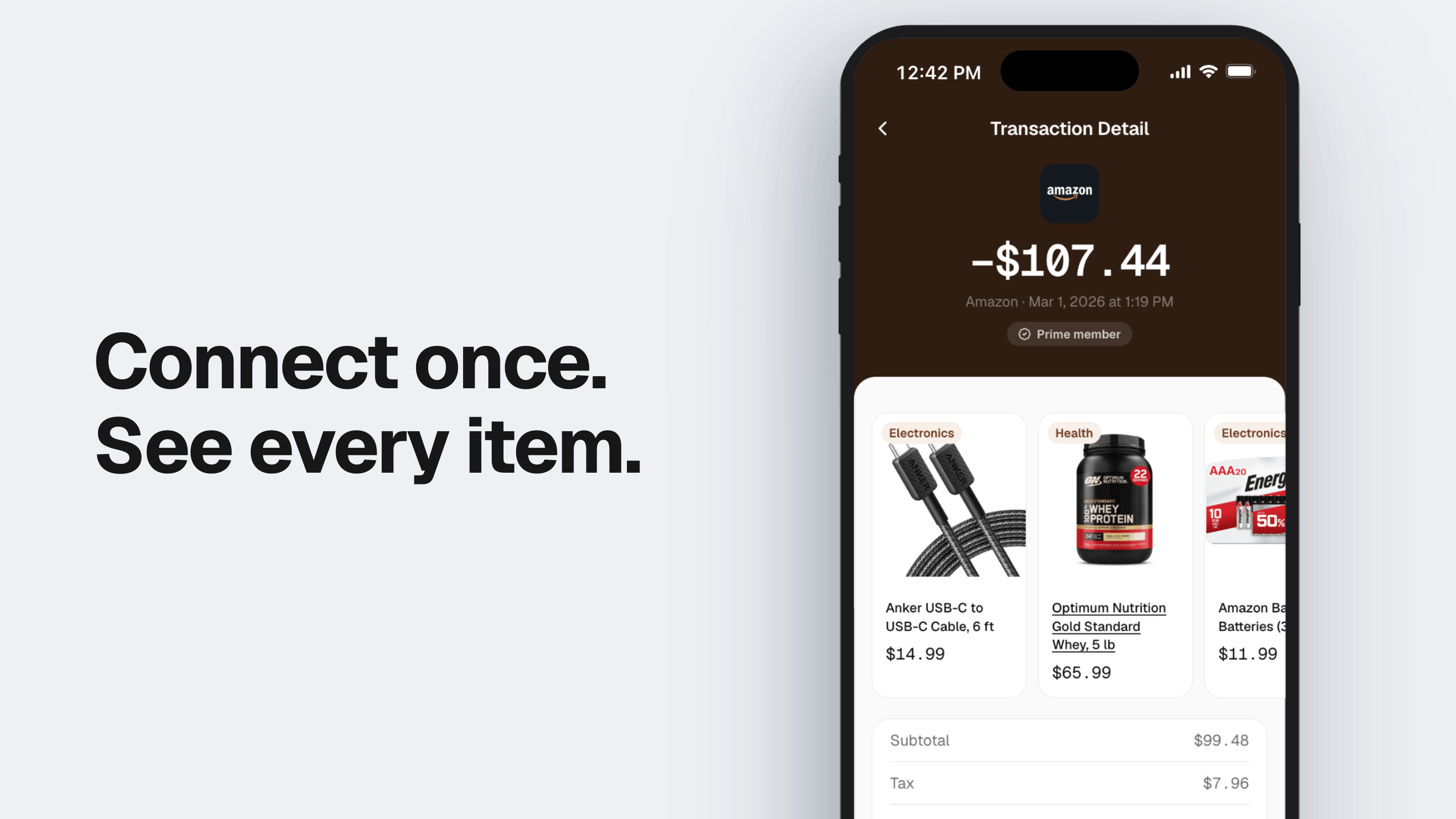
Try the interactive demo
Transaction data
Each transaction includes all of the following information:- Exact products (SKUs) that were included in the purchase, including their brand name, price, and quantity. This qualifies the transaction data as Level 3 (L3) and provides extreme granularity into a user’s spending habits.
- Payment method(s) used in the transaction (e.g. card, BNPL, Apple Pay, cash, etc.), whether single-tender or split-tender, providing share-of-wallet and competitive insights.
- Receipt-level price information, including the subtotal, list of adjustments (e.g. tax, tip, fees), and total.
- Status of the order (e.g. shipped, delivered, picked up, etc.), unlocking fulfillment lifecycle visibility.
- Much more…
- Both historical and future transactions.
- Both online and in-store transactions.
- Transactions made on all payment methods, including competitive payment methods to the card(s) you may issue (e.g. other cards, digital wallets, BNPL providers, cash, etc.).
Featured use cases
Additional use cases
AI-assistant
If you have plans to integrate an AI-financial assistant into your product (or already have this concept), such a tool becomes significantly more powerful with access to a user’s SKU-level transaction data. The assistant could monitor a user’s purchasing behavior, unlocking any of the following “sub-use cases”:- Smart budgeting suggestions, such as “You’re buying snacks three times a week — switching to bulk orders on Amazon could save you
$25/month.” - Anomaly detection, such as “You usually spend
$60–$80on groceries, but this week’s Walmart order was$150. Was that intentional?” - Receipt-level contextual responses, such as being able to answer “Show me what I bought at Target last Tuesday”.
- Cashback recommendations by identifying existing brands purchased and recommending for example “You could earn 5% back this month on your La Croix purchase if you buy at Target.”
- Financial coaching, such as mentioning “You spent
$120on takeout this week — that’s 3× your usual average. Cooking twice at home could save$80/month.” - Cross-sell product recommendations, such as “I noticed you use Affirm frequently to pay for products at Walmart. Take a peek at our new XYZ credit product to lower your rate.”
- Personalized shopping assistance, such as offering the following: “You usually buy school snacks from Walmart. Want me to check if Target has them cheaper this week?”
- Meal planning by offering relevant recipes like “You bought pasta, sauce, and garlic bread today — want me to suggest three 20-minute dinner recipes using those ingredients?”
Competitive insights
Share of wallet
Each transaction includes the payment method(s) used for the purchase across all payment methods stored in the user’s merchant account (the full list found here). Therefore, for a given user or across your entire user base, you can determine the spend going towards competitive payment methods. This can give you a sense for how much spend you could be capturing onto your card, as well as the % of spending you’re already capturing across grocery, retail, and other discretionary spend.Cross-sell new products
For users purchasing with competitive payment methods to your own card or other payment products, you can determine that certain of your payment products may be desirable alternatives to those users. For example, you may identify users purchasing with BNPL products and choose to offer them access to your new credit card that offers better rates and more rewards.Rewards
Design a more tailored rewards program
Fundamentally, if you can understand the brands and even specific items or services that users purchase, then you can be more strategic about designing your rewards program. Through the identification of specific brand affinities across your user base, you can seek to develop more tailored merchant partnerships to provide more relevant reward offers to your users. You can even provide CPG-brand or item-level offers (as opposed to merchant-level).Brand & SKU-level reward offers
With SKU-level transaction data, you can create and offer CPG-brand and item-level reward offers to your users - cashback, points, discounts, or other incentives. Specifically, by monitoring exactly which brands a user purchases, you can offer rewards to that user on their brands-of-choice and different brand-specific offers to other users. This allows for a hyper-tailored rewards program. Additionally, you can easily determine that a user purchased a product from a specific brand (or even a particular product) and subsequently credit that user for their rewards. Examples:- “Earn 6x points on Under Armour socks at Target”
- “Earn 10% cash back on Spicy Cumin Hand-Ripped Noodles at Xian Famous Foods on DoorDash until 11/6/25”
EBT spending rewards
If a particular purchase is made with an EBT SNAP or other EBT balance, you will receive this information in each transaction. Therefore, you could offer rewards on EBT card spend for those frequently using government benefits to purchase groceries and other household staples.Savings
FSA/HSA reimbursement
Using the eligibility of each product in a transaction, you can determine whether a particular product is eligible to be retroactively reimbursed from an FSA/HSA account. If a product is eligible for reimbursement, automatically submit a reimbursement on the user’s behalf to save them money.Spending insights
Hyper-granular budgeting
You can automatically categorize purchases into categories far more granular than those possible with transaction data from open banking platforms or networks. Instead of relying on MCC codes or categories derived from MCC codes (via transaction enrichment providers), identify transaction categories based on precisely what is included in a purchase. Even categorize a single purchase across multiple categories. For example, let’s say you see that a user made the following $114.68 purchase at Walmart:- 2 bags of Smartfood white cheddar popcorn
- 1 bag of nacho cheese doritos
- 3 family-size bags of Tostitos scoops
- 2 cases of la croix sparkling water
- 2 packs of organic chicken breast
- 3 heads of lettuce
- 5 tomatoes, on the vine
- 1 bag of dry, basmati rice